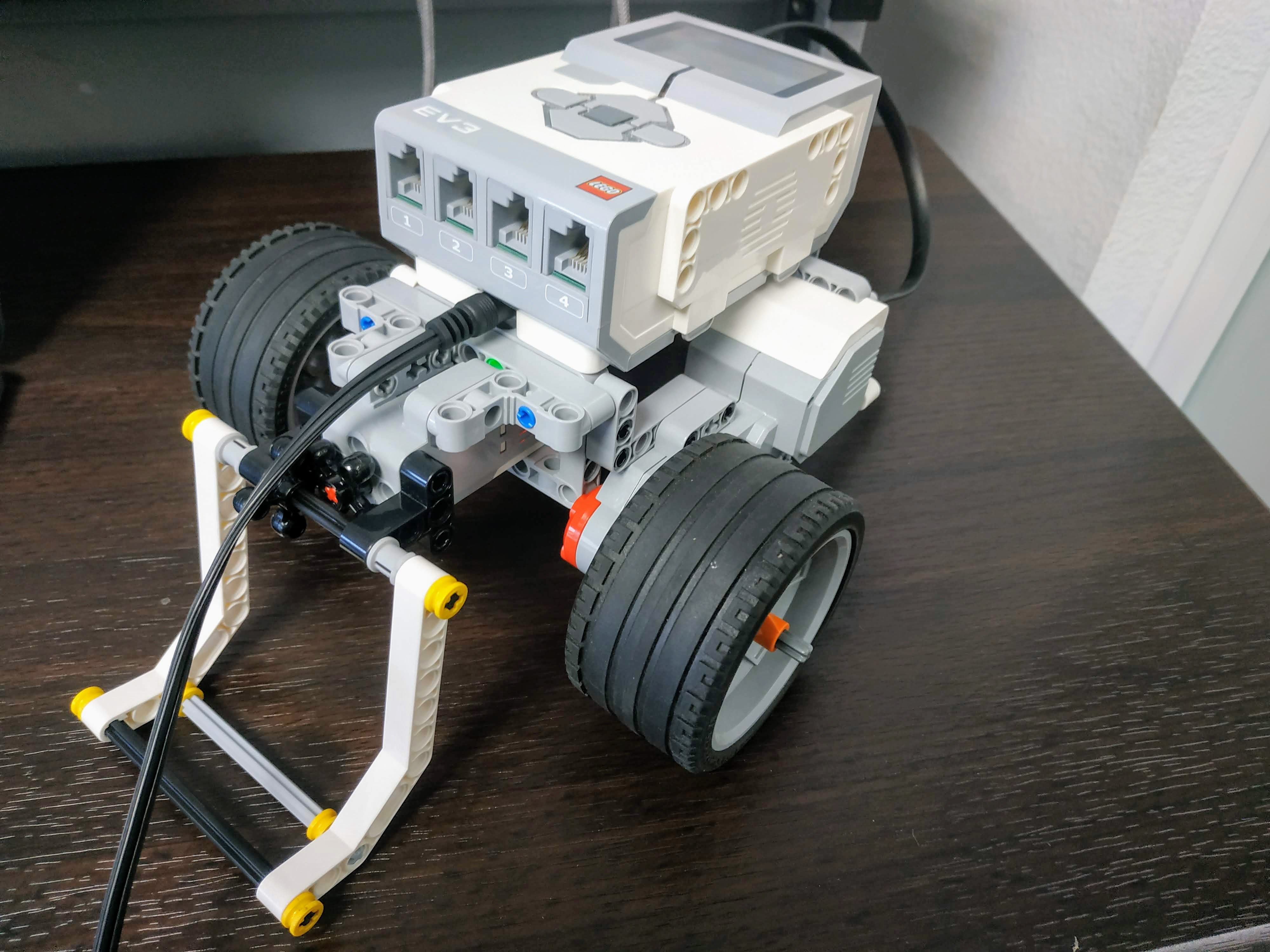
Kit contents at a glance
The standard EV3 Home Edition (31313) includes one EV3 intelligent brick, two large motors, one medium motor, one color sensor, one infrared sensor with remote beacon, one touch sensor, and 550+ LEGO Technic elements. The Education Edition (45544) replaces the infrared setup with an ultrasonic sensor and a gyroscope, and adds a rechargeable battery — changes that matter significantly for competition use.
The distinction between the two editions is frequently overlooked in school procurement. The gyroscope sensor alone is required for any meaningful autonomous navigation task, which means the Home Edition is functionally limited for teams preparing for FIRST LEGO League or WRO missions.
| Spec | Home Edition (31313) | Education Edition (45544) |
|---|---|---|
| Intelligent brick | EV3 (ARM9, 64MB RAM) | EV3 (identical) |
| Large motors | 2 | 2 |
| Medium motor | 1 | 1 |
| Color sensor | Yes | Yes |
| Ultrasonic sensor | No | Yes |
| Gyroscope | No | Yes |
| Touch sensor | 1 | 2 |
| Battery type | 6× AA | Rechargeable Li-ion |
| Approx. retail (PLN) | 950–1100 | 1400–1600 |
Programming environments
LEGO's official EV3 software, now branded EV3 Classroom, uses a block-based visual interface that runs in a browser or as a desktop application. It connects via USB or Bluetooth. For students new to programming logic, the block interface is accessible — drag-and-drop loops, conditionals, and sensor-reading blocks map directly to physical robot behavior, which makes debugging intuitive.
The limitation appears when students need to move beyond basic sequencing. The block environment does not expose array manipulation, custom data structures, or floating-point math in a way that is practical for complex autonomous routines. Teams serious about FLL competition often migrate to MicroPython on EV3 (supported since 2019 via the official LEGO Education MicroPython image for VS Code) or use ev3dev, a Debian-based Linux distribution that runs directly on the EV3 brick and supports Python, C, C++, and other languages.
Moving from the block editor to ev3dev-based Python typically happens in the second year of competition preparation. The jump is significant — students need basic Python knowledge and comfort with a terminal — but the flexibility gained is substantial.

Where it fits in the Polish curriculum
The Polish national curriculum for informatics at the primary school level (klasy 4–8) includes an introduction to algorithmic thinking and block-based programming. The EV3 aligns well with this scope — lessons covering sensor-triggered conditions, motor sequences, and loop structures correspond to informatics objectives outlined in the core curriculum (podstawa programowa) issued by the Ministry of Education.
At the secondary level (liceum), EV3 is less commonly used in formal lesson plans. Its role there is primarily extracurricular — robotics clubs and competition teams rather than classroom instruction. Schools participating in FIRST LEGO League Junior or standard FLL generally fund EV3 Education Edition kits through EU co-financed grants (e.g., laboratory modernization funds) or parent association budgets.
Practical limitations
Three issues come up repeatedly in practice with the EV3:
- Motor encoder drift: The large servo motors accumulate small positional errors over time. Without gyroscope feedback (absent in the Home Edition), straight-line driving over 50+ cm becomes unreliable.
- Bluetooth latency: Wireless programming via Bluetooth introduces noticeable delays during live testing. USB is faster but physically constraining in a workshop setting.
- LEGO software end-of-life: The original EV3 programming software (EV3-G) was discontinued and replaced with EV3 Classroom, which changed the file format. Teams using older lesson materials may encounter compatibility issues.
EV3 vs SPIKE Prime
LEGO Education released SPIKE Prime as the successor to EV3 in 2019. SPIKE Prime uses a more capable hub (faster processor, colour display, built-in 6-axis IMU), Python-first programming via LEGO Education SPIKE App, and a different connector standard (LPF2 vs RJ12). For new school purchases in 2025–2026, SPIKE Prime is the more future-proof option — FLL has been transitioning to SPIKE-based kits. However, EV3 kits already in school inventory remain fully functional and competitively usable through at least the 2026–2027 season.
Summary
The EV3 Education Edition remains a capable entry point for school robotics when supplemented with the ultrasonic sensor, gyroscope, and a path to text-based programming. The Home Edition is appropriate for introductory workshops but insufficient for competition preparation without additional sensor purchases. Schools making new acquisitions in 2026 should evaluate SPIKE Prime alongside EV3, particularly if they intend to participate in FLL events beyond the 2026–2027 season.
Further reading: Official EV3 product page (LEGO Education) · ev3dev project documentation

